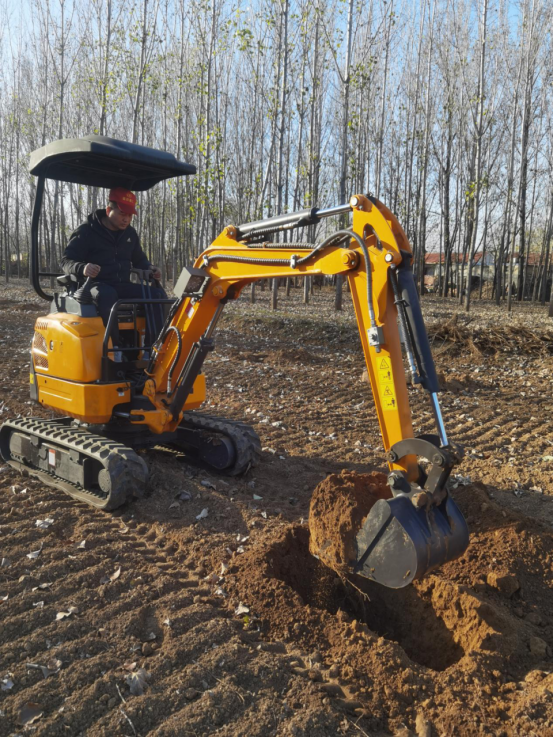
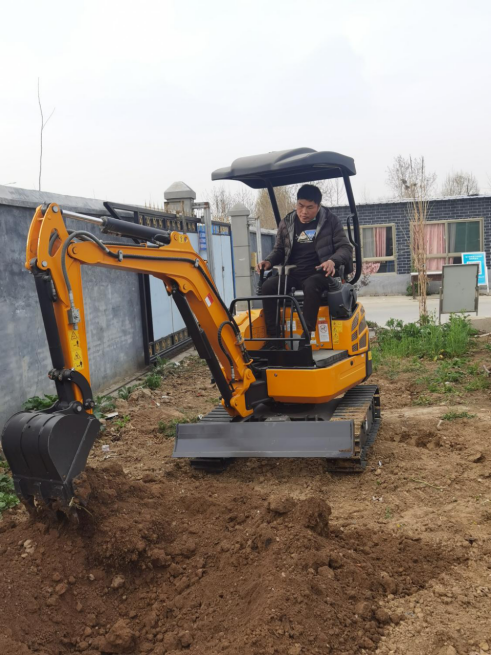
Golf course bunkers are not merely iconic landscape features; they are pivotal obstacles that dictate shot strategy. The curvature of the bunker's outline, the slope of its floor, and the transition of its edges directly determine the course's competitive nature and visual appeal. Bunker construction involves precision earth-shaping; while heavy machinery can easily crush and damage existing turf and micro-topography, manual excavation is labor-intensive and time-consuming, making it difficult to achieve smooth, natural contours. Compact excavators—thanks to their compact bodies, precise hydraulic controls, and versatile attachments—have become the primary equipment for excavating and shaping golf bunkers, balancing construction efficiency with shaping accuracy.
The first step in bunker construction is layout and positioning based on design blueprints, followed by the initial excavation. Golf bunkers often feature irregular shapes, complex curved surfaces, and subtle variations in depth, demanding exceptional control during excavation. Traditional large excavators have wide swing radii, making it easy to damage the surrounding, already-finished fairway terrain. Jining Jinwang compact excavators feature a compact body and a zero-tail-swing design, allowing for agile movement in tight spaces; their crawler undercarriages exert low ground pressure, maximizing protection for the existing turf and minimizing the need for remedial landscaping. Equipped with high-performance hydraulic systems, Jining Jinwang machines offer linear, controllable digging force. Operators can perform incremental, shallow excavation to precisely control the bunker floor depth and slope angles, avoiding issues like over-excavation or an uneven floor. Excavated soil can be redistributed on-site to shape the raised lips and earthen mounds surrounding the bunker, while excess soil is quickly transported to other fill areas on the course—eliminating the need for additional transport machinery and streamlining the entire construction process.
Once the rough excavation and initial shaping are complete, the process moves to the stage that truly tests technical skill: fine shaping and finishing. Golf course bunkers require natural, gentle curves; the base cannot be flat but must incorporate a drainage slope, and the edges must blend smoothly into the surrounding turf without harsh, abrupt angles. This is precisely where the Lipai compact excavator excels. Supporting a hydraulic quick-coupler, the machine allows for the rapid swapping of attachments—such as buckets, dozer blades, and rakes—offering versatile, multi-functional performance. The dozer blade is used for rough grading the base and slopes, while the terrain rake combs the surface soil, breaking up clods and clearing away stones and roots. It also allows for the fine-tuning of bunker lips and slope contours, sculpting the natural, undulating shapes envisioned by the designer.
Novice contractors often overlook bunker drainage; however, the drainage slope must be established during the base shaping phase to prevent future issues like rainwater pooling or silt contamination. Thanks to the precise, responsive controls of the Jinwang compact excavator, operators can make minute adjustments to the base contours, creating stable drainage slopes and laying a solid foundation for the subsequent installation of drainage pipes, geotextiles, and filter media. Throughout the shaping process, the machine’s movements are smooth and controlled; it sculpts aesthetically pleasing bunker profiles without disturbing the undisturbed native soil of the base, thereby ensuring structural stability.
In terms of performance, the Jinwang compact excavator delivers robust power. It handles challenging conditions—such as clay or mixed-soil environments—with ample digging force and strong climbing ability, maintaining stability even on undulating fairway terrain. Low vibration and noise levels minimize disruption to the surrounding environment during construction. Compared to traditional construction methods, a single Lipai compact excavator can independently handle multiple tasks—including excavation, earthmoving, rough slope shaping, and base leveling—significantly reducing labor requirements, shortening construction timelines, and lowering project costs. Whether for the batch construction of bunkers on a new course or the renovation of existing ones, the Jinwang compact excavator delivers consistent performance, balancing high efficiency with meticulous precision. Constructing golf course bunkers is a task that truly tests craftsmanship in the details. Modern course shaping is no longer merely a contest of raw excavation power; instead, it prioritizes equipment agility, precision control, and versatility. Thanks to their outstanding performance and comprehensive range of attachments, Jinwang compact excavators effectively address common challenges—such as the difficulty of bunker excavation, insufficient precision in shaping curved surfaces, and the risk of large machinery damaging the course. Consequently, they have become highly acclaimed earthmoving and shaping machines for landscaping and golf course construction projects. From excavating the bunker's outline to meticulously refining its slopes, a single compact excavator can transform a design on the blueprint into a course feature that is both competitively challenging and visually stunning.